How long are you planning for?
Most of us plan our money to last thirty years and then quietly hope to live a lot longer than that. I put the contradiction to a group of investors in Lisbon: two true stories, a thought experiment, and where I land.
16 July 2026 · 4 min read
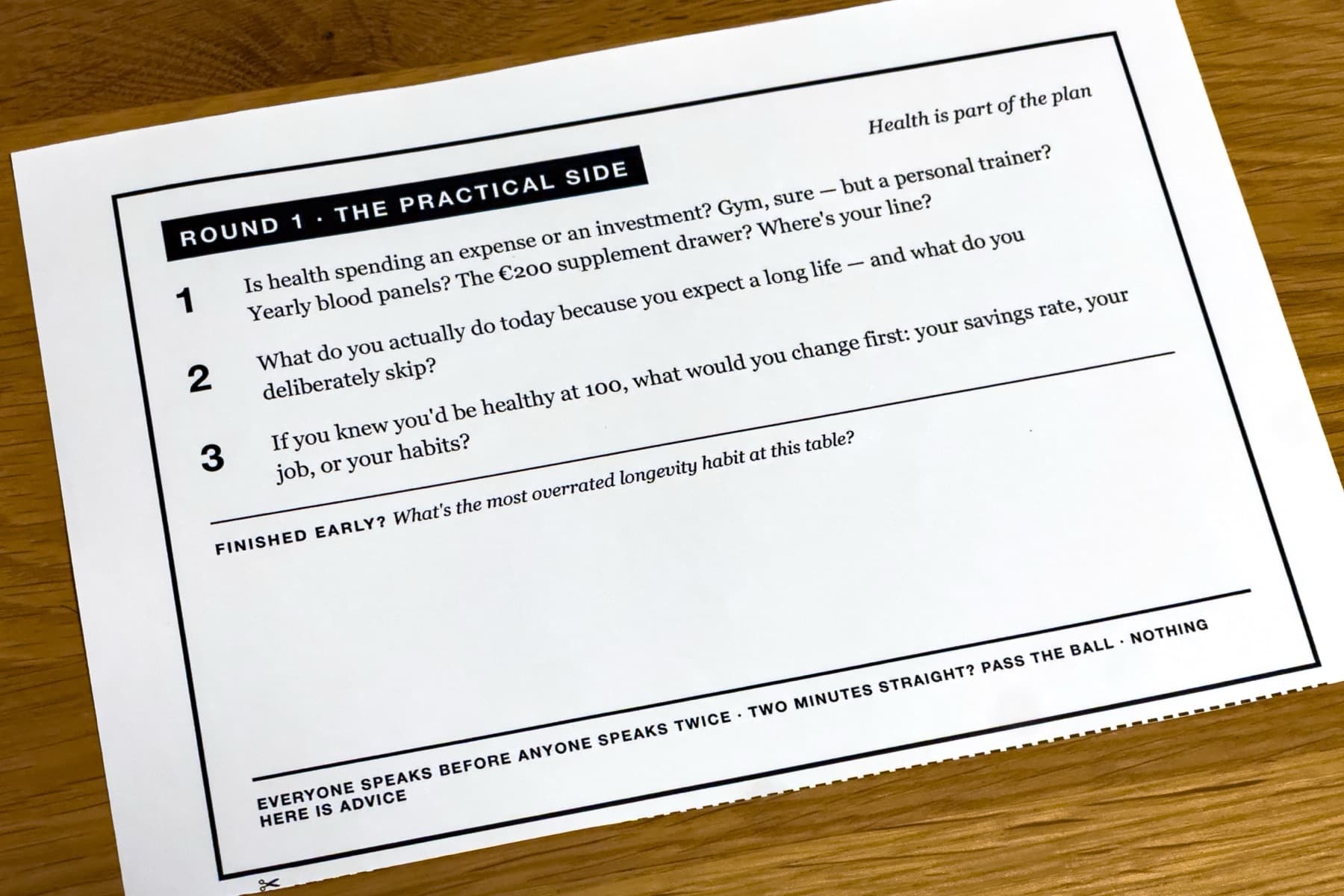
Last evening I ran a roundtable in Lisbon. A group of investors, tables outside, dinner, no slides. The subject was money and a longer life. I opened with a show of hands: who's planning for their money to last to 80? To 100? To 120? A few brave hands at the far end. For a lot of the table, it was the first time anyone had asked them to pick a number at all.
That's the whole reason I wanted to run it. Every retirement plan has one number nobody argues about: how long you're going to live. We'll argue about withdrawal rates, stocks versus bonds, savings rates, forever. The length of the retirement we take from a table somewhere and move on. Usually thirty years.
The famous 4% rule was built exactly that way: 1990s US data, a thirty-year retirement. Retire at 65, plan to 95, done. As long as there's a dollar left at year thirty, it counts as a success. I don't count that as a success. I retired at 34. If I lean on that same rule, I'm asking it to run sixty or seventy years, a question it was never built to answer.
So here's my own answer, said plainly: I'm not planning for thirty years, or sixty. I'm planning for forever — a portfolio built to outlast me, however long I live. In practice that means a withdrawal rate around 3.33% and, for me, everything in stocks, with the only real discipline being not to panic when they fall. Not advice, just my own sums, shown elsewhere.
Then I got out of the way and let the table do the work. Two stories from the tables stuck with me, and they sit at opposite ends of the same point.
The first: a relative of someone there, given three to five years to live, who waited two and a half for a transplant on the public system — and got twenty more years out of it. He hadn't planned to die that soon. He certainly hadn't planned to still be here. The people who get more time almost never budgeted for it.
The second is the opposite mistake. Someone brought up Jorge Guinle, the Brazilian heir whose family built the Copacabana Palace, who dated half of Hollywood, and who set out to die without a cent to his name. His own line: "the secret of living well is to die without a cent in your pocket — but I miscalculated, and the money ran out too early." He'd meant for the money and the life to run out together. He lived to 88, the last years broke, in a hotel his family used to own. Spending it all is only a plan if you know the date. You don't.
The whole problem lives between those two poles. Plan short and get long, and you end up like Guinle. Fix on any date at all, and you're betting on the one number you can't see.
We made it concrete with a thought experiment: a pill that buys you ten healthy years, but a one-in-a-hundred chance it kills you tonight. Take it? The table said no, near-unanimously, until I dropped the odds to one in a thousand, and hands began to move. The answer didn't matter. What mattered was watching people find their own price on time. Most had never once named it.
That's the speculative edge of the night: an idea called longevity escape velocity, where medicine might one day add more than a year of life expectancy for every year that passes. Nobody knows if we get there. Could be decades, could be never. But you don't need it to be likely. You only need it to be possible for it to change the plan you make today.
The plainest hour, though, was the most useful, and it wasn't speculative at all: is money spent on your health an expense, or an investment? The table mostly landed on investment, with one caveat worth keeping. A personal trainer is an investment only if the goal is to eventually not need one. Throw money at your health expecting it to change nothing, and it's just a bill.
A pharmacist there put the other side of it better than I could: stay on the default path and, past a certain age, you get medicated. And the medication cascades, into your budget, your independence, and the people who end up caring for you. Health isn't a line item next to the retirement plan. It's inside it.
And it's the part you can actually move. A big share of the life expectancy we've won came from fewer children dying, not from 90-year-olds becoming 110-year-olds. So the ceiling isn't really yours to raise. What is yours is how many of the years are good ones, and the levers there are cheap and boring: sleep, food, exercise, not smoking, showing up to the check-up. That's most of it. The rest is detail.
I built a small thing for exactly this question, The Three Endings: put in your numbers and it shows, at every age, your odds of being alive and funded, alive and broke, or gone. For the roundtable I added a switch to it: push your life expectancy out ten or twenty years and watch what a longer life does to the money. That shift is the whole conversation, in one chart.
Here's where I landed with the table, and where I'll leave you. I don't know if anyone there reaches 120. Nobody does. But two things are true either way: the health habits pay off even if the science never arrives, and a plan built for a very long life is just a good plan anyway. So build for the long version. If you turn out to be wrong, it cost you being too safe: a real price, and the cheaper of the two mistakes.
The hands moved a little by the end: a few more people planning for longer than when we started. So here's the question I sent them home with, and I'll leave it with you too: how long are you actually planning for, and when did you last pick that number on purpose?
— Pablo